
Long-Range Active Stand-Off Chemical Detector
FALCON 4G
FALCON 4G
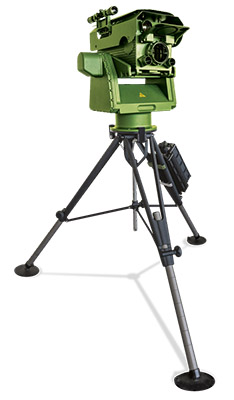
FALCON 4G is a 4th‑generation, active stand‑off detector that detects, identifies and quantifies chemical warfare agents (CWA) and toxic industrial chemicals (TICs) at long range. It uses eye‑safe, undetectable pulsed CO₂ lasers and Differential Absorption LIDAR (DIAL) to pick up gas clouds at distance, report concentration and range‑to‑cloud (no triangulation needed), and provide mission‑ready mapping outputs for command. It’s designed to work in hot desert, harsh winter, high humidity and marine environments, with no calibration required.
Why teams choose FALCON 4G
- Long‑range coverage: platform capability up to 6 km; see “Extended” below for sensitivity/range uplift.
- Better sensitivity than passive systems (vendor comparison), with independence from background temperature.
- Laser is undetectable by laser‑warning devices, supporting covert reconnaissance.
- Distance‑to‑cloud readout without triangulation, plus no need to scan background or use refractors.
- Proven in trials (TNO, DEVCOM CBC, DTRA CBOA, AEWE, VVÚ) and tested with real CWA.
Key specifications
- Operating principle: Active DIAL with two pulsed, tunable CO₂ lasers (eye‑safe).
- Spectral coverage: 9.2–10.78 µm; FoV 1 mrad.
- Weight: ≈ 30 kg (detector). Battery power draw: ≈ 25 W.
- Range: up to 5 km with the standard CHEM pack (see below); up to 6 km with Extended.
- Support & UX: No calibration; pan‑tilt positioner, telescopic sight, low‑light camera; CBRN 4/plot‑style mapping outputs in software.
Mounting & deployment
Vehicle, vessel, helicopter, building or tripod‑portable; battery unit (about 7 hours typical) with Falcon Interface Unit for control.
Typical applications
- CBRN reconnaissance and perimeter overwatch with quantified concentration and range‑to‑cloud
- Industrial/TIC monitoring (pipelines, tank farms, ports)
- Maritime, border and event security where stand‑off is mandatory.
FAQs
Is the laser eye‑safe and covert?
Yes, Class 1 eye‑safe; undetectable by LWRs per vendor testing.
Do we need to calibrate it?
No routine calibration; the platform is “no calibration needed.”
Does background temperature affect results?
The platform is independent of background temperature.