
Compact Pedestrian Gamma Radiation Portal
PoliGate™ Light G1
PoliGate™ Light G1
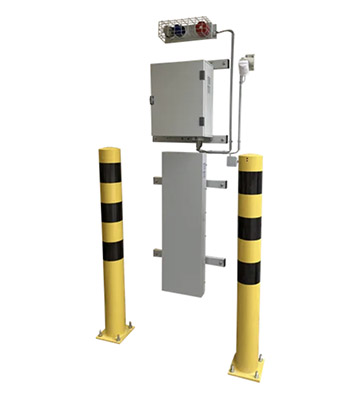
Portal-grade gamma checks, minimal footprint
The PoliGate™ Light G1 is a one-sided, gamma-only radiation portal monitor for Australian ports, borders, waste sites, and critical infrastructure. A compact 8.8 L plastic scintillator block, integrated lead shielding, and smart occupancy sensing deliver continuous screening of vehicles, trolleys, and pedestrians without forcing them to stop.
Paired with modular mounting hardware, a rugged electronics cabinet, and operator workstation software (your “companion app” at the gate), G1 supports an end-to-end workflow from installation and tuning through to alarm review, video confirmation, and long-term reporting.
Why Teams Choose PoliGate™ Light G1?
- High sensitivity in a small footprint: 8.8 L plastic scintillator with lead shielding delivers strong response to ¹³⁷Cs, ⁶⁰Co, and medical sources from a single pillar.
- Flow-friendly operation: Rated for 1.5 m × 2 m control zones and 5 km/h traffic, so lanes keep moving instead of stopping at the portal.
- Rugged, outdoor-ready build: IP55 enclosure, −30 to 50 °C temperature range, and 98 % RH capability suit Australian yards, ports, and exposed gates.
- Power resilience: Wide-range AC input with >8 h internal 12 V battery keeps monitoring and alarms online during power cuts.
- Standards-aware design: Partial alignment to IEC 62244 and ANSI N42.35 plus EMC and safety standards, supports regulatory comfort and integration.
What’s in the Kit?
PoliGate™ Light G1 gamma detection block, electronics/control cabinet with integrated 12 V backup battery, local light and sound alarm hardware, occupancy sensors, mains power connection hardware, Ethernet interface, operator software licence, installation and user documentation.
Talk to our RPM specialists today to size PoliGate™ Light G1 correctly for your lane, standards, and radiation-threat profile.
PoliGate™ Light G1 Key Specs
- Type: One-sided, gamma-only radiation portal monitor (RPM).
- Detector: Organic plastic scintillator, 8.8 L volume with integrated lead shielding.
- Radiation: Gamma only, 20 keV – 3 MeV.
- Control zone (G1): 1.5 m (W) × 2.0 m (H) at up to 5 km/h object speed.
- Minimum detectable quantities (typical, background <0.1 µSv/h, FAR <1/1000):
- ²⁴¹Am – 1380 kBq (≈37 µCi)
- ¹³⁷Cs – 230 kBq (≈6.2 µCi)
- ⁶⁰Co – 120 kBq (≈3.1 µCi)
- ⁵⁷Co – 220 kBq (≈5.9 µCi)
- ¹³³Ba – 130 kBq (≈3.4 µCi)
- ²³⁸U – 1400 g; ²³⁵U – 83 g; ²³⁹Pu – 2.9 g
- False alarm rate: <1/1000 passages (under stated conditions). ● Power: 90–260 V AC, 50/60 Hz (wide-range), with internal 12 V rechargeable battery (>8 h backup).
- Comms: Ethernet to operator PC / control room.
- Environmental: IP55; −30 to 50 °C; 88–106.7 kPa; up to 98 % RH at 40 °C.
- Detection block dimensions: ~1074 × 324 × 127 mm (H × L × W).
- Detection block weight: ~66 kg.
Frequently Asked Questions
What radiation does PoliGate™ Light G1 detect?
G1 is a gamma-only portal. It detects increased gamma fields from industrial, medical, and nuclear materials; neutron detection is handled by other Polimaster RPM families, not the Light G1.
How rugged is the system for yard and port environments?
The detection block is IP55-rated, operates from −30 to 50 °C, and tolerates high humidity. Combined with a 66 kg, lead-shielded pillar, it’s engineered for exposed gates, waste yards, and industrial entrances.
What does the operator use as a “companion app”?
PoliGate™ Light G1 connects via Ethernet to an operator workstation running Polimaster portal software. That software displays live counts, alarms, and trends, logs events, and can integrate with optional video for visual confirmation.
Is G1 compliant with homeland security RPM standards?
The Light series is documented as partially compliant with IEC 62244 and ANSI N42.35, and meets EMC and electrical safety standards such as IEC 61000-6-2/6-3, IEC 61326-1, EN 55022 Class B, and IEC 61010-1. Formal approval still depends on local testing and regulator requirements.
Compliance note: All specifications, detection limits, and standards references are based on manufacturer documentation and may change without notice. End users are responsible for confirming local regulatory acceptance, site licensing, and export controls before procurement and deployment.