
Autonomous GPS‑Guided Precision Airdrop
Sherpa™ Precision Aerial Delivery System (PADS)
Sherpa™ Precision Aerial Delivery System (PADS)
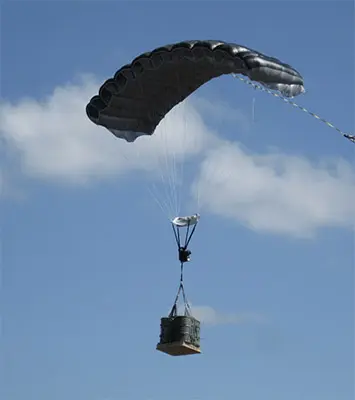
Deliver critical cargo accurately — without forcing aircraft into low‑level threat envelopes.
MMIST Sherpa™ is a modular, GPS/GNSS‑guided parachute delivery system designed to autonomously deliver cargo from high altitudes and significant stand‑off distances into a predetermined, small‑area drop zone. It is built for rugged, repeatable performance and is designed to integrate with common aerial delivery container systems and be deployed from fixed‑wing and rotary‑wing cargo aircraft.
By combining a programmable HALO/HAHO drogue delay with an advanced guidance and navigation control system, Sherpa™ helps teams achieve high delivery accuracy without the operational risk of dangerous low‑level flight — supporting resupply and logistics into hard‑to‑reach areas and complex environments.
Why teams choose Sherpa™
- Stand‑off survivability: Enables high‑altitude drops to increase distance from hazard zones and reduce reliance on low‑level aircraft runs.
- Autonomous operation: Designed to minimise operator workload while adapting to mission conditions.
- Modular flexibility: One AGU can be paired with multiple canopy options to cover wide payload ranges with simplified spares and asset management.
- Small‑area accuracy: Built for precise delivery outcomes (typically referenced as ~100 m class accuracy, configuration dependent).
- Integration-ready: Designed to pair with MMIST planning and insertion tools (LaunchPADS™, SkyLink™, Drop Sondes) for an end‑to‑end workflow.
Applications
- Military operations: Delivery of essential equipment and high‑value cargo to remote or hostile areas.
- Disaster relief: Rapid delivery when infrastructure is damaged or landing areas are limited.
- Humanitarian response: Accurate autonomous delivery to reduce risk to crews and improve last‑mile reliability.
- Commercial logistics: Support for remote industry (e.g., mining, oil & gas, research sites) and complex supply chains.
System overview
At the core of Sherpa™ is the Airborne Guidance Unit (AGU), available in two variants. Each can be configured with ram‑air parachute systems suitable for the required payload range. Each parachute is paired with a drogue parachute to support HALO/HAHO deployment, with a user‑programmable release mechanism to achieve the desired opening altitude (configuration dependent).
AGU variants (at a glance)
| AGU variant | Typical payload range | AGU weight | Battery | AGU size (H × D × W) |
|---|---|---|---|---|
| Ranger AGU | Approx. 45–544 kg (100–1,200 lb) | Approx. 24 kg (51 lb) | 1 × military Li‑ion (BB‑2590/U) | Approx. 44 cm × 21 cm × 34 cm |
| Provider AGU | Approx. 45–3,400 kg (100–7,500 lb) | Approx. 29 kg (62 lb) | 2 × military Li‑ion (BB‑2590/U) | Approx. 44 cm × 21 cm × 41 cm |
Operational capability highlights
- Deployment envelope: Up to approx. 8,840 m AMSL (29,000 ft, parachute dependent), with minimum deployment altitudes from roughly 1,070 m AGL (3,500 ft) and up (parachute dependent).
- HALO/HAHO support: Programmable drogue delay (GPS altitude, pressure altitude, or time delay — configuration dependent).
- Landing options: Into‑wind approaches, user‑selectable approach heading, and optional manual control via remote control factory option.
- Data links: Mission planning data via wired USB or wireless (802.11 b/g/n), with radio/data‑link options available depending on configuration.
- Security: Selectable automated log‑file erase / rendering unusable to reduce risk of unauthorised access (configuration dependent).
Optional features (configuration dependent)
- Remote control / in‑flight re‑tasking: Override autonomous flight for obstacle avoidance near the landing area, and/or re‑programme the landing point while in flight.
- Visible and IR lighting: Assist operations in low‑light/night environments.
- Maritime recovery support: Waterproof AGU option with automatic flotation triggered on water contact.
- GNSS options: Commercial GNSS constellation support (e.g., Navstar/GPS, Galileo, GLONASS) and optional military GNSS module (where applicable).
Works as part of the MMIST ecosystem
- LaunchPADS™: Mission planning and management for guided cargo deliveries and complex aerial release scenarios.
- SkyLink™: Parachutist situational awareness and (when configured) Sherpa™ remote control support.
- Drop Sondes: Real‑time wind data collection to refine release points and improve delivery outcomes.
Key environmental characteristics
- Operating temperature: approximately -60 °C to +60 °C (when operated in accordance with the operator manual)
- Waterproofness: immersion to 1 m for 30 minutes (IPx7 class testing referenced)
- Functional shock: up to 20G (testing referenced)
Build a safer, more accurate stand‑off resupply capability. Contact J3Seven to scope the right Sherpa™ configuration (AGU variant, canopy options, comms/data links, and mission planning integrations) for your aircraft and payload profile.
Frequently asked questions
Is Sherpa™ fully autonomous?
Sherpa™ is designed for autonomous operation using its guidance and navigation control system. Depending on configuration, a remote control option can allow manual override for obstacle avoidance or in‑flight landing point updates.
What payload weights can Sherpa™ deliver?
Payload range depends on the AGU and parachute configuration. MMIST lists a system coverage of approximately 45 kg to 3,400 kg (100 to 7,500 lb), with the Ranger AGU supporting up to approximately 544 kg and the Provider AGU supporting up to approximately 3,400 kg.
What aircraft/container systems can it integrate with?
MMIST notes Sherpa™ is designed to integrate with common aerial cargo payload/container systems (including CDS and other standardised approaches) as well as custom payloads, subject to integration and mission configuration.
Can Sherpa™ support night or maritime operations?
Yes, optional visible/IR lights can support low‑light operations, and a maritime recovery configuration can include a waterproof AGU with flotation triggered upon water contact (configuration dependent).