
Real‑Time Wind Profiling
Drop Sondes
Drop Sondes
Measure the winds you’re actually flying in — not yesterday’s forecast.
MMIST Drop Sondes are consumable atmospheric data sensors deployed from an aircraft to capture a current wind profile and key atmospheric conditions from flight level down to the ground. As each sonde descends, it uses GPS positioning to track drift with the horizontal winds and transmits data back to a receiver on the aircraft (or optionally on the ground), enabling crews to make better release decisions for both cargo delivery and personnel insertion.
Drop Sondes are designed to feed measured wind data into mission tools such as LaunchPADS™ Mission Manager, helping crews refine and dynamically adjust Calculated Air Release Points (CARP) for improved delivery accuracy.
Why teams choose Drop Sondes
- Real‑time data transmission: Get current winds and atmospheric data to support on‑the‑fly mission adjustments.
- Improved CARP accuracy: Measured wind profiles help refine release point calculations for planned airdrops or parachutist jumps.
- Compact and lightweight: Designed for straightforward deployment from aircraft.
- Built for harsh conditions: Engineered for reliable operation across demanding environments and weather conditions.
- System integration ready: Designed to integrate directly into LaunchPADS™ workflows, with options to share data onward to SkyLink™.
What Drop Sondes measure
- Wind speed and direction (derived from GPS drift through the air mass)
- Barometric pressure
- Temperature
How it works (simple workflow)
- Deploy: A sonde is released from the aircraft and descends under a small stabilising drogue parachute.
- Track: GPS data is used to determine the sonde’s position while it moves with horizontal winds.
- Transmit: The sonde sends its GPS coordinates to a receiver (typically on the aircraft; optionally ground‑based).
- Calculate winds: The receiver/system calculates wind speed and direction from the transmitted data.
- Use immediately: Upload the measured wind profile into LaunchPADS™ Wind Sonde Module to optimise and dynamically adjust CARP.
Seamlessly integrated with LaunchPADS™ Wind Sonde Module
The Drop Sonde system supports real‑time wind and atmospheric data collection to enhance release point planning. In LaunchPADS™, crews can view active sondes and manage incoming wind data to provide the most current wind information available for precision aerial delivery missions and airborne insertion.
Optional: share wind data to jumpers via SkyLink™
Drop Sondes can be configured to provide a direct link from the Base Station to SkyLink™ over Bluetooth Low Energy (BLE), supporting real‑time wind awareness for parachutists (configuration dependent).
System components (roll‑on / roll‑off kit)
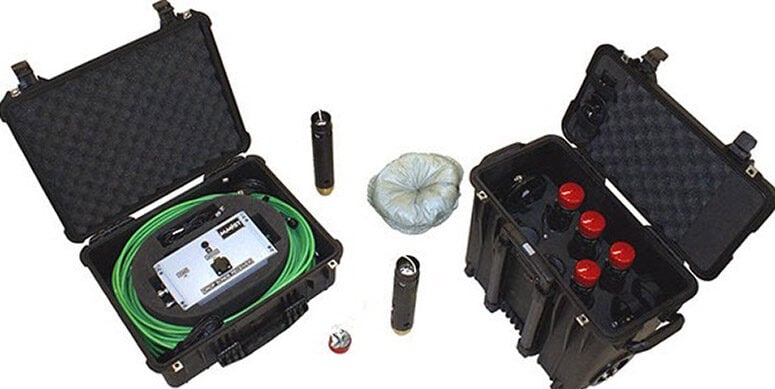
The Drop Sonde System is designed as a roll‑on, roll‑off atmospheric data collection system consisting of:
- Drop Sonde: Cylindrical sensor deployed from the aircraft, with a small stabilising drogue parachute.
- Base Station / Deployment kit: Holds up to six (6) sondes, supports pre‑flight charging and pre‑deployment testing, and helps improve GPS lock/retention inside the aircraft using an external active GPS antenna.
- Receiver / Base Station interface: Receives sonde transmissions and connects into the LaunchPADS™ mission manager computer workflow.
- Fully rugged computer: Touchscreen‑capable rugged laptop intended for use in unpressurised aircraft at high altitudes.
- Antenna options: Works with either an exterior aircraft‑mounted “shark fin” antenna or an internal temporary Yagi antenna (handheld or mounted).
- External GPS antenna + RF antenna: Supports signal performance for reliable data reception.
Improve aerial delivery and insertion accuracy with measured, real‑time wind data. Contact J3Seven to configure Drop Sondes with LaunchPADS™ (and optional SkyLink™ data sharing) for your aircraft and operating profile.
Frequently asked questions
What’s the main operational benefit of Drop Sondes?
They provide current, measured winds and atmospheric conditions between flight level and the ground, which can improve the accuracy of CARP calculations for cargo airdrops and parachutist jumps.
Where is the receiver located?
Typically on the aircraft the sonde is deployed from. MMIST also notes the Base Station can be located on the ground near the airdrop area (optional).
How many sondes does the kit support?
The transport/deployment kit is designed to hold up to six (6) sondes and supports pre‑flight charging and testing.
How does it integrate with LaunchPADS™?
Measured wind data is uploaded into the LaunchPADS™ Mission Manager Wind Sonde Module, enabling crews to optimise and dynamically adjust Calculated Air Release Points (CARP).