
Single‑Use Cargo Airdrop Parachutes
LCADS (Low Cost Aerial Delivery System)
LCADS (Low Cost Aerial Delivery System)
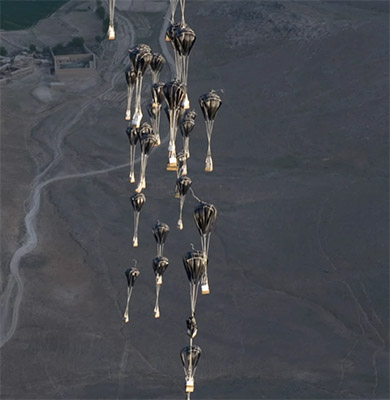
When the mission says “deliver and move on”, LCADS keeps aerial delivery simple, fast, and cost‑effective.
LCADS is a low‑cost aerial delivery system developed and certified by NATICK US Army Labs as a lower‑cost alternative to the A‑22 Container Delivery System (CDS) for missions where recovery or re‑use of the delivery system is unlikely. It replaces traditional nylon with lower‑cost polypropylene and uses construction methods designed to enable procurement from numerous manufacturing sources outside the normal parachute manufacturing industry.
While LCADS was designed for one‑time use, systems that are recovered and show no obvious visible signs of damage may be repacked for more than one use. Offering both Low Velocity (LV) and High Velocity (HV) variants to suit different drop profiles and risk environments.
Why teams choose LCADS
- Cost‑effective by design: Lower‑cost polypropylene materials reduce system cost versus traditional nylon cargo parachutes.
- Single‑use efficiency: Ideal when retrieval is impractical or operationally risky.
- Wide mission fit: Suitable for humanitarian aid, disaster relief, and military operations.
- Fast to field: Delivered pre‑packed with simplified payload rigging instructions to reduce prep time.
- LV and HV options: Select a descent profile that matches altitude constraints, winds, and DZ conditions.
- Turn‑key campaign support: MMIST can provide full aerial delivery services including rigging, training, mission planning, and execution.
Load range & compatibility
- Suspended load range: approx. 227–998 kg (500–2,200 lb)
- Container compatibility: Low Cost Container (LCC) and A22
- Typical cargo aircraft compatibility: Designed to support airdrop from cargo aircraft including C‑130, AN‑12 and IL‑76 (platform integration and mission approvals apply).
Low Velocity LCADS
Best for: Low‑altitude airdrops where deployment altitude is limited and a lower descent rate is preferred for robust supplies.
- Suspended load: approx. 227–998 kg (500–2,200 lb)
- Deployment altitude: approx. 229 m AGL to 3,962 m AMSL (750 ft AGL – 13,000 ft MSL)
- Typical descent rate: approx. 9.1 m/s (30 ft/s)
- Certified deployment speed: 0–150 KIAS (0–278 km/h IAS)
- Container compatibility: LCC and A22
High Velocity LCADS
Best for: Higher‑altitude aerial delivery where low‑altitude drops are impractical or too risky. HV systems use smaller parachutes, making them less susceptible to wind and helping reduce drift.
- Suspended load: approx. 227–998 kg (500–2,200 lb)
- Deployment altitude: approx. 914 m AGL to 7,620 m AMSL (3,000 ft AGL – 25,000 ft MSL)
- Typical descent rate: approx. 18.3–27.4 m/s (60–90 ft/s)
- Certified deployment speed: 0–150 KIAS (0–278 km/h IAS)
- Container compatibility: LCC and A22
What J3Seven can deliver
- LCADS system supply (LV and/or HV)
- Component supply to match your existing rigging approach
- Campaign support: rigging, training, mission planning, and delivery execution
Need a cost‑effective cargo airdrop solution for operations where recovery is unlikely? Contact J3Seven to select the right LCADS velocity type and configure your container and aircraft integration approach.
Frequently asked questions
What’s the difference between LV and HV LCADS?
LV LCADS is intended for lower‑altitude drops with a slower typical descent rate. HV LCADS supports higher‑altitude delivery with faster descent rates and smaller parachutes that are generally less affected by wind.
Is LCADS strictly single‑use?
LCADS is designed for one‑time use. However, MMIST notes that recovered systems with no obvious visible signs of damage may be repacked for more than one use.
What payload weights can LCADS support?
LCADS supports suspended loads of approximately 227–998 kg (500–2,200 lb).
What containers are compatible?
MMIST lists compatibility with the Low Cost Container (LCC) and the A22.